
It is deeply ironic to write about the Kelly Criterion immediately after putting together a piece on loss. Maybe that is what a sufficiently large loss does to you. You spend years accumulating increasingly complicated heuristics, only to eventually find yourself returning to the basics and asking yourself the very same questions you did when you were just starting out.
The conflicting nature of risk and reward in markets, and particularly within crypto markets where I remain most active, has a remarkable ability to make fools out of even the most sophisticated market participants. The same characteristics that make an opportunity attractive enough to be deemed life-changing, and in markets there are many facades of the kind, are precisely those capable of absolutely decapitating you at times when you least expect it. Somewhere in between lies the difficult needle to thread: betting enough when you are right for it to actually matter, without self-microwaving yourself prematurely at the most inconvenient moment, potentially just as the market is about to bless you.
John Kelly's original insight was deceptively simple, and to this day goes over many participants' heads, and for a while mine too. The objective was not to maximise the expected value of any individual bet, but to maximise the long-run growth rate of one's capital. In the simplest case, where a win pays one-for-one, you win with probability p, lose with probability q=1-p, and wager a fraction f of your stack each time; wealth after a sequence of wins and losses becomes:
Kelly then asks which f maximises the expected logarithmic growth of that wealth:
and swiftly arrives at a simple answer:
If your probability of winning an even-money bet is 51% and losing is 49%, your edge is 2%, and full Kelly says to wager 2% of your wealth. A lesson well understood within the poker cohort: if there is no edge, there is no bet.
This is where the idea itself turns attention-grabbing and, if executed correctly, can be mouthwatering. The relationship between bet size and long-run growth is not linear.
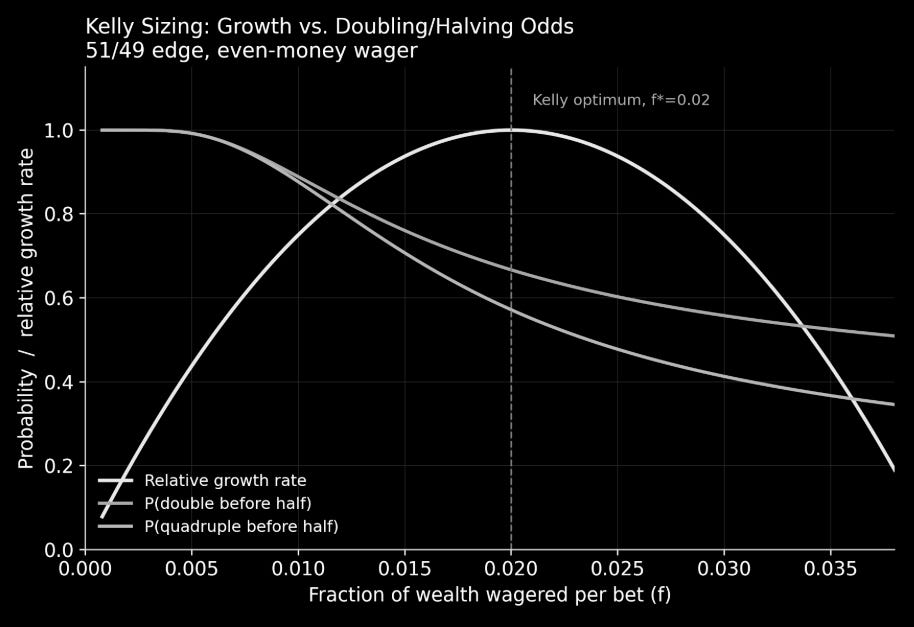
Let's take blackjack, in a scenario where p=0.51 and q=0.49, expected growth peaks at a 2% wager - betting less sacrifices some growth in exchange for security. Betting more initially increases risk while reducing growth. At roughly twice Kelly, the excess long-run growth has been driven back towards zero (rather sad). Beyond this optimum, you are not taking more risk for more expected compound growth. You are essentially taking more risk for less, which is counterproductive and is self-flagellation.
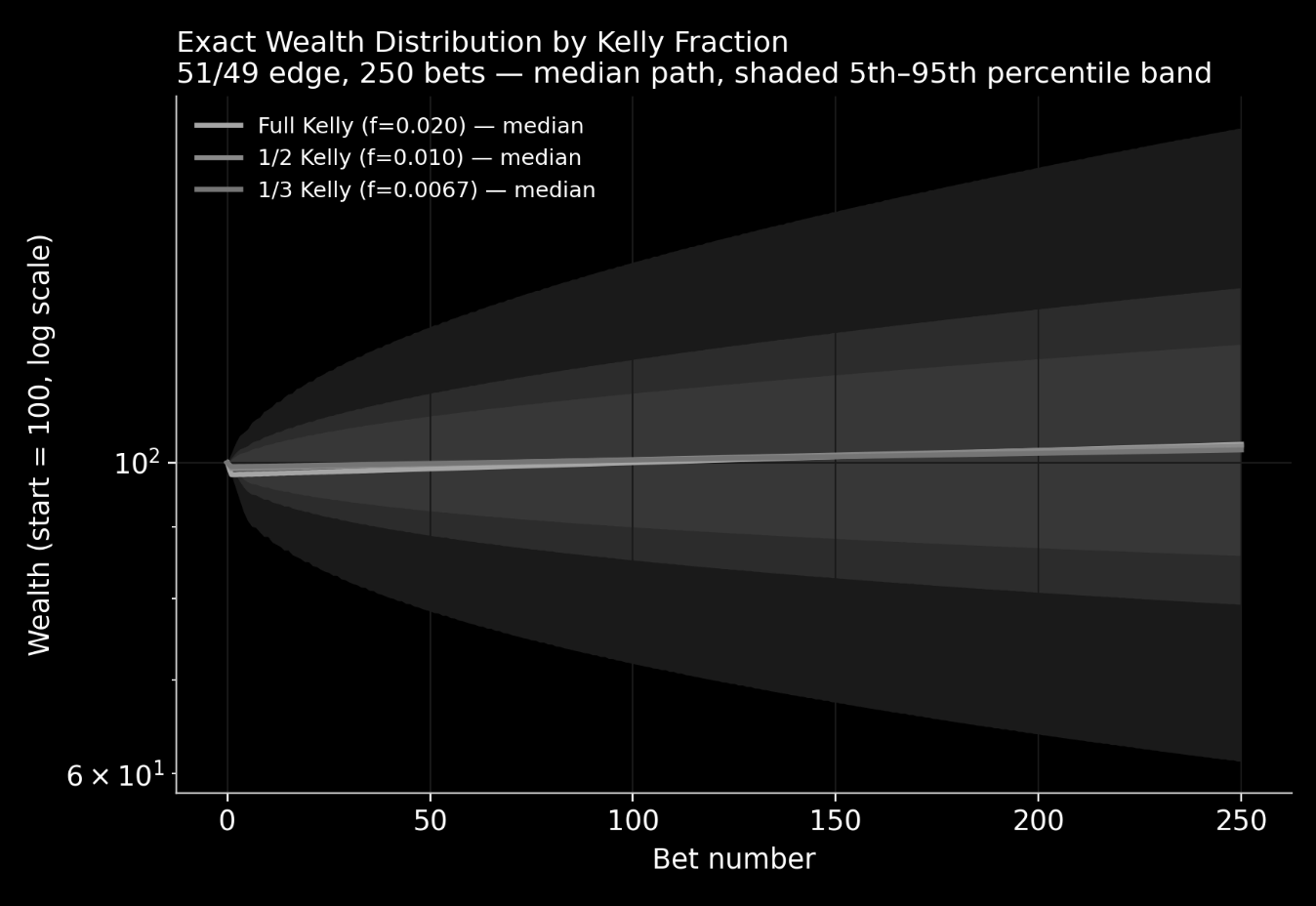
This figure summarises the entire piece in a single chart.
Crypto naturally attracts and often treats as sacrifice the participants who struggle with this lesson. It is difficult to watch somebody have a generational run on something you understood before them and remain satisfied with a sensibly sized position. The temptation is always to add another turn of leverage, another few percentage points of book, another mouth-filling helping from the soup of shit. If the expected value is positive, why would you not?
And therein lies the problem. Having an edge does not imply that you should bet everything.
Alright, imagine an even-money wager where you have a 99% probability of winning and only a 1% probability of losing. Kelly does not tell you to bet everything. It tells you to bet 98%. While the remaining 2% looks almost irrelevant, once you consider a potential scenario of what happens when the 1% outcome eventually arrives, it is a life-saver.
As obvious as this may come off, the markets do not hand us p on a silver platter. It is mostly an assumption or an estimation - research views and directional bias dressed up as probability.
In crypto, your supposed 70% trade might actually be 55%. Your expected 3:1 payoff might become 1.5:1 because liquidity disappears on the way out, the expected home run is impaired by a crook’s tricks or other potential shenanigans occurring within the space. Correlations that looked benign can converge towards one when conditions deteriorate, or the market is spooked. Kelly is highly sensitive to estimation error, particularly errors in expected returns, and this becomes increasingly dangerous for aggressive investors (which, historically, I have been).
This is where fractional Kelly starts to make considerably more intuitive sense. Half Kelly is not an admission that you are not outright a believer in the trade. It is merely an admission that you are not blindly confident of your own ability to come to a perfect synthesis in a world full of force majeure, and the burden of truth can often extract a heavy price, far beyond what one can often stomach.
Half Kelly is sacrificing some long-term growth in exchange for substantially greater sense of security. Simulations below repeatedly show smoother wealth paths as the Kelly fraction falls.
There is a siren song that appears in quiet markets, telling you that the next trade deserves to be larger or a friend screaming in your ear about this one being a sure play, and your sizing will leave you sidelined on the juicy price action, but just as Jez’s bio: “I must not fomo”.
Perhaps nothing has happened for an extensive period; maybe the market was slow, or you lacked conviction to pull the trigger on a set basket of opportunities. You have watched other people get disturbingly rich, and to some level it is deeply infuriating. Your own PnL has gone sideways in the meantime, or it was decent, but simply nothing to write home about. Then something finally appears that you understand deeply, and every instinct tells you that this is the moment to make it all back, potentially make the year, or make enough that you never have to care again - this could be the elephant you were waiting to pass by. A truly intoxicating thought.
Kelly’s answer is irritatingly sobering: even when you are right, there is such a thing as betting too much.
That sounds painfully obvious until money is involved, making it rather simple to get jaded.
In crypto, actors like Jez (one of the goats) consistently make a core argument around sizing and trade construction that I increasingly find difficult to disagree with. Why would you put meaningful capital behind your second or third-best idea?
If you have genuine confidence in your own judgement, concentration is not necessarily the enemy, right? Poorly constructed concentration is. There is an enormous difference between betting heavily on an asymmetric opportunity you understand (the so-called “good new thing”) and overleveraging yourself desperately seeking the outcome.
The distinction becomes particularly difficult because conviction itself is endogenous. 99 out of every 100 participants are bullish when price has just gone up and bearish as soon as a sufficiently violent red candle prints, with reasons coming post-factum. We observe the price, develop the emotion and then construct an intellectually respectable explanation for why we felt it and why we positioned. This is somewhat forgivable due to crypto trends, but trading solely by looking backwards is not trading at all.
I try to think about this through who is actually taking the other side. I want to buy assets when competent participants are starting to think about a name and the story behind it. Not to sound overly negative or cynical, but I become considerably less interested when fickle retail, shallow pockets and weak conviction are the marginal buyer. When everyone who can become bullish already is bullish, there is very little oxygen left in the room and time is of the essence. Sentiment can be euphoric, and little can drive it to improve further. Yet even a pin drop can shock sentiment the other way; hence you have to position accordingly.
These things have a way of building on themselves. Price inherently creates sentiment, sentiment creates flows, flows create price, and before long everyone is waxing poetically about whatever narrative happens to be working. The tail starts wagging the dog. Eventually price becomes the thesis rather than an expression of it.
The same thing happens on the way down. Suddenly nobody wants to touch what they were falling over themselves to buy weeks earlier. The underlying facts may have barely changed, but the perceived probability distribution has shifted enormously because the number on the screen is red. Gravity is allowed to do the rest at that stage, and it never fails to.
This is why sizing is inseparable from psychology. The theoretically optimal bet becomes useless if the path towards realising it makes you abandon the trade altogether. A position that causes you to stare at the screen, trade your PnL rather than the situation and hide your head in the ground is probably too large, irrespective of what your estimations or write-ups might say.
And this is where the simulations get real uncomfortable and turn real all of a sudden.
Not to flog a dead horse, but this is perhaps the counterintuitive part. Overbetting does not merely increase volatility. Once you move beyond Kelly, you begin destroying the very growth rate you were attempting to maximise. Once the fraction exceeds full Kelly, growth deteriorates sharply while standard deviation accelerates in the opposite direction.
You have somehow achieved the worst of both worlds by taking on more risk with less growth and for what?
All this to say, blowing up is not romantic at all. It is maximum pain, pure hell.
There is nevertheless something seductive about ruin that markets occasionally romanticise. We love the story of the trader who lost everything, put his back against the wall and found the next play, making it all back and more. I understand; I have unfortunately been there, borrowing from my own past more than I would like to admit. There is something unique and almost special about that state: it is inevitably just you, skills you attained over the years, experience and the inevitable truth that you must win; you have no choice. The noise starts to dissipate. The hunger takes over and replaces complacency. Every move, every decision ends up mattering again. All while you have the bitter taste of ash under your tongue, even when you win - it does not go away.
I am not by any means trying to glorify it. But if you are unfortunate enough to find yourself there, there is a certain hunger worth savouring. Perhaps adversity forces a clarity that abundance slowly erodes. When you have less room for error, you stop humouring mediocre ideas and entertaining utter fluff. You stop putting on trades due to being bored or feeling sidelined. You stop allocating capital to your 7th best trade or having too many positions on, simply because the first 6 are not available.
The danger, in turn, becomes mistaking that said hunger and state of desperation for a strategy.
There is a siren song somewhere in every market. It tells you that this time the opportunity is sufficiently extraordinary to warrant getting just a little closer, adding another turn of leverage, or abandoning whatever constraints you had set while still thinking clearly. For a while, it sounds beautiful and is extremely appealing. Every additional move in your favour only makes it harder to resist.
The problem is rarely failing to recognise the said danger. It is believing that when the moment arrives, you will somehow exercise restraint. There is something to be said for deciding how close you are willing to get before you can hear the music.
The opportunity can be real, and you know the song can be worth hearing. Your construction still needs to leave room for being right imperfectly.
Markets are full of versions of this. You identify the correct asset but choose to use too much leverage. You understand the catalyst but get the timing or the trade execution wrong. You correctly anticipate the move but cannot survive the chosen path - correct ex ante, and the market simply did not let you live to be right. You make 300% and refuse to take the gift because 500% has somehow become the new baseline; you get greedy. Had I closed here and taken the gift is one of those sentences every trader eventually says to himself.
The urge to victory lap makes this worse. There is no music sweeter than somebody telling you that you were right, particularly after everyone doubted your idea and told you that you were wrong. The temptation is to allow being right once to become evidence that you are right about everything; no one, and I repeat, no one, is. It is a fallacious leap, however seductive it feels at the time. Position size creeps higher. Standards deteriorate. You get sloppy. The market rewards the behaviour just long enough for you to mistake recklessness for skill.
Then again, gravity does its thing.
Kelly is useful precisely because it separates the quality of an idea from the amount you should risk on it. An exceptional trade does not require existential sizing. In fact, the entire point of having an edge is to remain alive long enough to express it, and do so repeatedly.
That might be the part I appreciate more now than I would have a year ago. Survival itself has optionality.
You really do not want to self-microwave yourself before the opportunity set becomes extraordinary. You want enough capital, emotional collateral and conviction left when the genuinely asymmetric trade finally arrives. There is no prize for identifying the elephant if you have already emptied the gun shooting at squirrels and rats.
At the same time, excessive caution carries its own cost. If you spend your entire life betting 20 basis points on things you believe have extraordinary expected value, you have solved risk of ruin by quietly introducing risk of irrelevance. The question arises once again: why put capital behind your 2nd or 3rd best idea when your best idea is sitting directly in front of you?
That tension is what I find peculiar. Not risk versus safety, but survival versus potential consequence. Bet too much and eventually the market outright removes you from the table. Yet you bet too little and being right barely matters.
The Kelly Criterion provides us with a formula. Markets, on the other hand, leave us with the much harder task of determining the inputs and adequately executing the set idea. It rewards being process-oriented over results-oriented, even when the market insists on grading you the other way.
Maybe that is why returning to something so elementary after writing about loss does not feel that ironic at all. Perhaps it is the natural conclusion one comes to after having committed sufficient mistakes? Sophistication begins to look suspiciously similar to understanding the basics unusually well.
All this to say: have an edge, size it properly, avoid confusing price with information, do not trade the PnL instead of the situation, take the gift when the market gives it to you, keep an eye out when everyone else has their face in the ground. And above all, remain solvent enough to bet when the odds finally become obscene.
I started this one intending it to be half the length, which is, fittingly, its own sizing problem I failed to solve. Even a rant has an optimal fraction to wager it at, and I suspect I have already overbet this one.
“First shalt thou reach the Sirens; they the hearts
Enchant of all who on their coast arrive.”