

It has been roughly six weeks since Blur launched Blend, its lending protocol for NFTs, and I am still somewhat conflicted on what to make of it. The idea itself has made me curious. Blend is a peer-to-peer perpetual lending protocol where borrowers can use NFTs as collateral, without relying on price oracles or fixed loan expiries. Lenders make off-chain offers specifying the amount they are willing to lend and the interest rate they require, while borrowers can select whichever terms they are willing to accept. By default, the loan can then continue indefinitely.
In practice, this creates something resembling Buy Now, Pay Later for NFTs. A buyer does not necessarily need the full purchase price upfront and can instead borrow against the NFT, while an existing holder can access liquidity without selling their asset. There is an obvious appeal to this, particularly in a market where a large amount of value has historically sat relatively idle inside NFTs. It is also worth thinking about what happens when you introduce easily accessible leverage into a market already driven heavily by sentiment. My concern is less with Blend itself, and more with what happens when a fairly elegant lending mechanism meets a market that has historically been built on taking risk.
Buy Now, Pay Later (BNPL)
The comparison with BNPL is probably useful beyond simply describing the product. Part of what made products such as Klarna successful was not just access to credit, but the separation between buying something and actually feeling the cost of paying for it. Splitting or deferring payment lowers the immediate financial burden of a purchase, even if the underlying obligation remains the same - although I believe it will be exactly this that will likely haunt Klarna. Blend introduces a similar dynamic into NFTs. The ability to borrow against an NFT, or finance its purchase, makes it easier to take exposure without committing the full amount of capital upfront.
For borrowers, this is obviously more capital efficient, but it also creates the possibility of taking on more debt than they otherwise would. That is probably fine while prices are rising and liquidity is available. The more interesting question is what happens in the opposite environment. Borrowed capital can amplify demand on the way up, but leverage works both ways. If NFT prices fall towards or below outstanding loan balances, lenders become increasingly exposed to collateral that may no longer cover the debt, while borrowers may decide that repaying the loan no longer makes economic sense. Across enough positions, that can add another layer of reflexivity to an already extremely volatile market.
Importantly, Blend does not use a floor-price oracle to determine when that point has been reached. There is no automatic liquidation simply because the floor of a collection falls below some predefined threshold. Instead, the decision is effectively left to lenders and the market for refinancing. This is one of the more interesting parts of Blend’s design and an important distinction from how collateralised lending normally works.
Refinancing
A normal NFT-backed loan with an expiry creates an awkward predicament. If the borrower forgets or is unable to repay before maturity, they can lose the NFT even if the collateral is still worth considerably more than the debt. Blend removes the expiry altogether. Loans continue by default, with interest accumulating continuously. A borrower can repay at any time and, if neither side does anything, the loan simply remains outstanding.
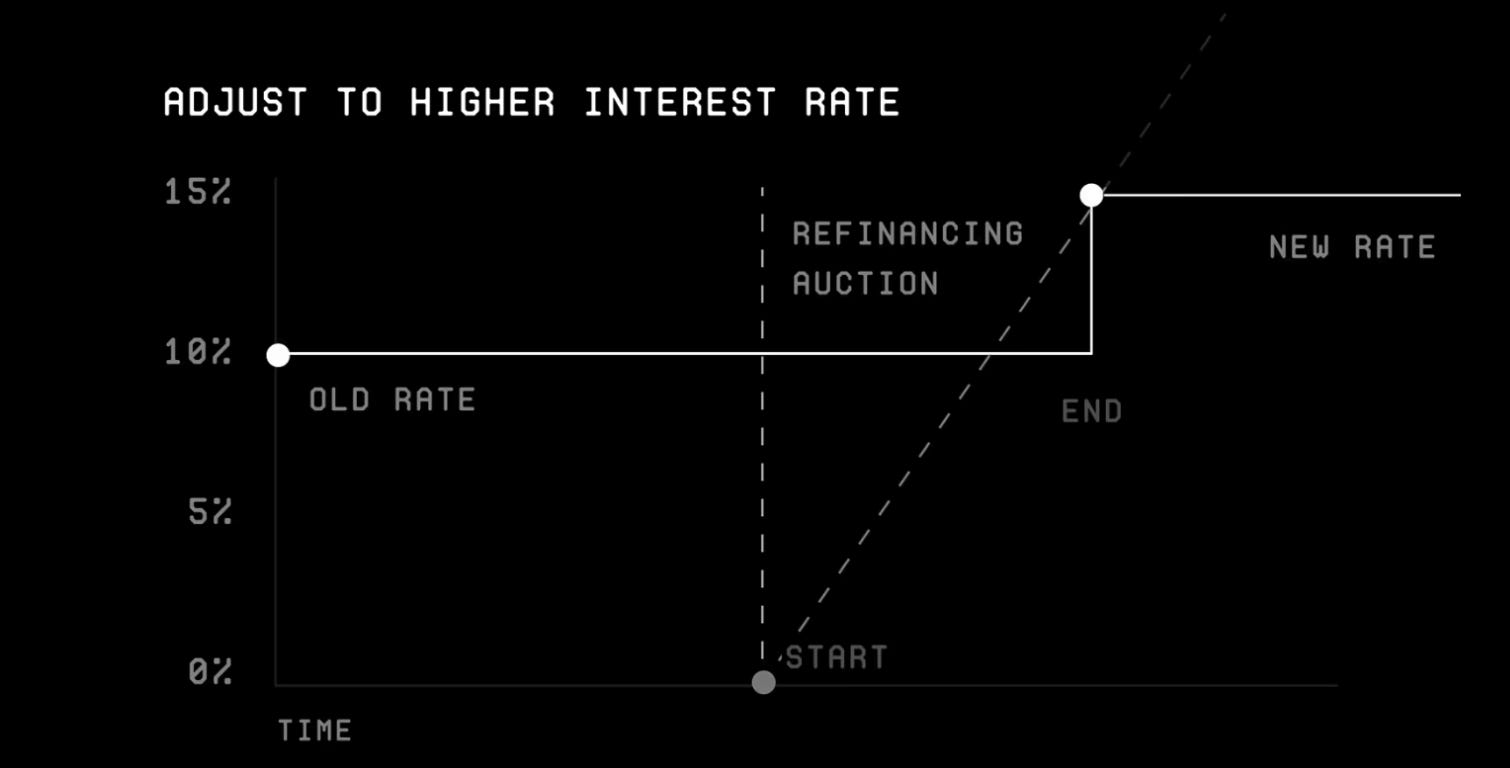
The lender, however, is not locked into the position forever. If they want their capital back, they can trigger a refinancing auction. Rather than immediately taking the NFT, Blend starts a Dutch auction in interest-rate space, where the rate available to a replacement lender gradually increases until someone is willing to refinance the debt. If another lender steps in during the auction, they repay the existing lender and take over the loan at the new rate. The borrower keeps the NFT, but now pays a higher interest rate.
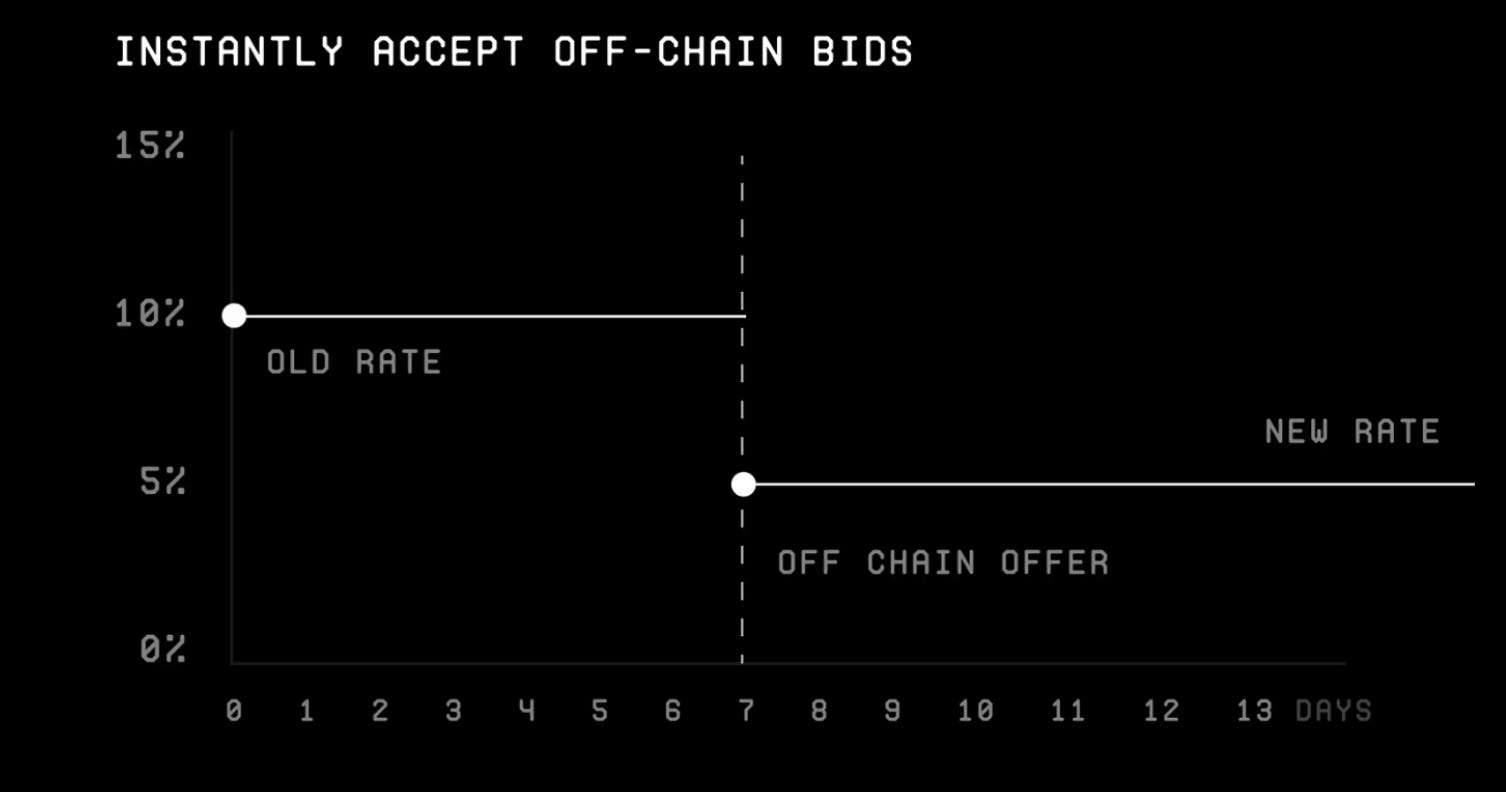
There is also a more favourable outcome for the borrower. A lender can submit a new off-chain offer against the NFT at any time. If that offer provides better terms, it can be used to refinance the existing loan immediately rather than going through the auction process. In the example below, a loan carrying a 10% rate is refinanced into an available 5% offer. The borrower keeps the NFT while reducing the cost of the loan.
These two outcomes are crucial as the refinancing mechanism is not necessarily punitive. Where there is healthy demand to lend against a collection, lenders can compete with one another, and borrowers may be able to maintain their positions at similar, or even better, terms. The more difficult situation is what happens when that demand disappears.
If the existing lender wants out and nobody is willing to refinance the debt, the Dutch auction continues, offering progressively higher interest rates to potential lenders. If it reaches the maximum rate without attracting anyone, the auction has effectively failed to find a market for the loan. At that point, the borrower is liquidated, and the existing lender can take possession of the NFT.
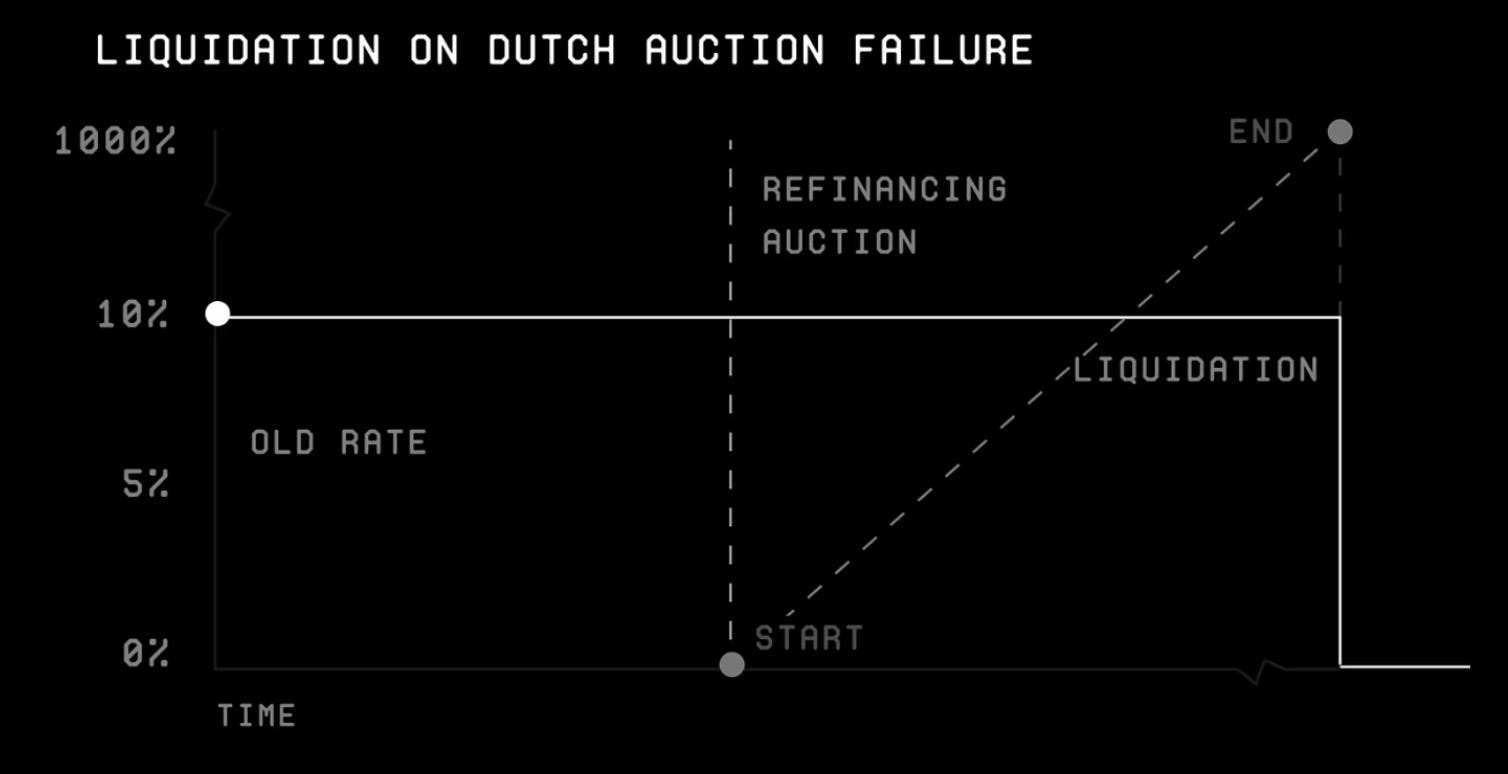
This is where the word perpetual probably needs some qualification. The loan has no predetermined expiry, yet that does not mean the borrower can necessarily keep it open forever. Its duration ultimately depends on somebody being willing to provide capital against the NFT. In a liquid collection with plenty of lenders, refinancing may happen relatively smoothly. In a collection where liquidity has dried up, the exact same mechanism can end with the lender taking the collateral.
I think this is one of the more interesting parts of Blend’s design. It replaces a fixed maturity date and oracle-based liquidation with something closer to continuous price discovery for the loan itself. Instead of the protocol deciding that an NFT is worth X amount and liquidating once a ratio is breached, the market is effectively asked whether somebody is still willing to finance the position, and on what terms. Six weeks in, it is difficult to know how well that process will hold up when liquidity becomes considerably thinner. That is probably where the mechanism becomes most interesting.
What is an NFT even worth though?
One of the reasons Blend avoids oracles is that valuing individual NFTs is difficult in the first place. Even the floor price of a collection is an imperfect reference point. NFT markets are relatively thin; individual assets within the same collection can have very different characteristics, and floors themselves can move considerably on relatively little volume. They can also be manipulated (which I would bet on if I were a betting man).
Rather than pretending there is an objective answer, Blend leaves the loan-to-value ratio to the lender. A lender decides how much ETH they are prepared to lend against a particular collection and at what interest rate. This is probably preferable to mechanically relying on a floor-price oracle, but it does not make the underlying valuation problem disappear. It simply moves the responsibility for solving it from the protocol to individual market participants. A lender who misprices the collateral can still end up holding an NFT worth less than the outstanding debt; the difference is that this happens because nobody is willing to refinance the position, rather than because an oracle has crossed some predetermined liquidation threshold.
There is also limited flexibility once a borrower wants to reduce the position. Blend currently requires the outstanding loan to be repaid in full rather than allowing partial repayment. A borrower can refinance into another loan, but cannot simply pay down part of the existing balance. For a product designed around flexible, continuous borrowing, that feels like an area that could become important as people begin managing several leveraged positions at once.
Few weeks in
What is perhaps most interesting is how quickly the market has adopted the product. Reported figures put cumulative loan volume at roughly one hundred million dollars within the first eleven days, rising beyond two hundred and twenty-five million by the end of its first month, and by most estimates comfortably beyond three hundred million as May came to an end.
There was clearly demand for this type of product, although whether the market has had enough time to understand how it behaves under stress is a different question. A few weeks is not particularly long, especially for a lending mechanism whose more interesting properties only really appear when lenders no longer want to lend. The distinction between the fairly painless refinancing case and the one where nobody is willing to step in probably matters far more in a weak market than it does while liquidity remains available.
That is ultimately what I find most interesting about Blend. The mechanism removes several obvious sources of friction from NFT lending. There are no expiries for borrowers to manage, no oracle determining what an NFT is worth, and no governance process deciding which loan-to-value ratio the market should accept. Those decisions are instead pushed out to borrowers and lenders. In theory, the market continuously decides whether a loan should exist. The difficult part is that markets tend to make those decisions very differently when liquidity disappears.
Regulation & Financialisation
None of this currently sits inside much of a regulatory framework. In some ways that is exactly what makes the product possible. Perpetual, oracle-free and cross-border NFT lending would be considerably harder to build within the constraints applied to conventional financial products. The trade-off is that there is less standing between borrowers and unfavourable terms, while the legal status of these structures remains uncertain across different jurisdictions. Depending on the jurisdiction, that creates questions around lending regulation, consumer protection and whether certain activity could eventually fall into existing financial rules. It is probably too early to know where regulators ultimately land.
There is also a broader question around what products like Blend eventually do to NFTs themselves. NFTs originally became valuable for a mixture of reasons: art, status, community, speculation and, at times, the simple desire to own something culturally relevant. Once an NFT can be purchased with leverage, borrowed against, continuously refinanced and ultimately liquidated, the relationship with the asset changes slightly. Something that might previously have been held as a collectable, piece of art or membership in a community increasingly starts to behave like a financial position that needs to be managed. Your original piece made much the same point: greater access to borrowed funds could encourage short-term speculation at the expense of the artistic and emotional value attached to NFTs.
That is not necessarily a bad thing, nor is it particularly unique to NFTs. Better financial infrastructure can make markets more liquid and capital more productive, and it may broaden the number of people able to participate. But there is probably a balance somewhere. The easier it becomes to leverage NFTs, the easier it also becomes for short-term financial incentives to crowd out some of the artistic or emotional reasons people wanted to own them in the first place.
My concern with Blend is therefore less that the mechanism itself is poorly designed and more what happens when a well-designed lending mechanism meets a market that has historically been fairly comfortable taking risk. Blend may end up being an important piece of NFT market infrastructure. There is nowhere near enough evidence to know now.
For now, the interplay between Blend’s BNPL service, the adoption of collateralised NFT lending and changing sentiment in the broader NFT market is something worth observing. How borrowers, lenders and collectors orientate around that delicate balance between financial engineering and the reasons these assets were valuable to people in the first place will probably tell us more than the first few hundred million dollars of loan volume.