

We live in an attention economy, where often vitality trumps substance and entertainment masquerades as purpose. Yet an entertainment phenomenon such as Sperm Racing still poses as the new ridiculous idea people can not help but share with their friends.
I would like to articulate that this is not an attempt to over-intellectualise gamblers putting capital behind a new format of betting, but rather diving into the core of what Sperm Racing is looking to achieve, the problematic side of male fertility at the moment and the result of 16- and 17-year-old founders getting together to disrupt a vertical with one of the most unique, crazy and creative ways.
Beneath the meme-worthy absurdity, there is a crisis unfolding. Male fertility rates continue to tank, and it does not seem to be an area getting much light shed on it. According to Human Reproduction Update, global sperm counts have dropped by 59% between 1973 and 2011. More recent studies suggest the rate of decline has accelerated to >2.6% per year since 2000. At this trajectory, the average man could reach sperm counts below the threshold for fertility by 2045. This is a societal problem unfolding.
The causes are manifold, from endocrine-disrupting chemicals, processed food, sedentary lifestyles, chronic stress, nicotine use (guilty), rising obesity rates, to excessive screen time. Male testosterone levels have declined in lockstep, dropping nearly 1% per year for the last four decades. A study from the Journal of Clinical Endocrinology and Metabolism showed that a 60-year-old man in 2004 had testosterone levels 17% lower than a 60-year-old in 1987. Rather crazy to think about.
As a result, it is no surprise to see the rise of TRT clinics, once a medical solution for hypogonadism, now repackaged as a lifestyle upgrade. Joe Rogan, Dana White, Jeff Bezos, and many more have actively spoken out about their TRT usage. The narrative has shifted from pathology to optimisation. To think that society turned default into an intervention. In a way, “synthetic” testosterone is the answer not to disease, but to normal decline.
Meanwhile, IVF is no longer niche; it has turned pretty mainstream. The global IVF market is expected to surpass $36b by 2028 (what a great business), driven by delayed childbearing, declining fertility, and more same-sex couples and single parents opting for assisted reproduction. In Denmark, >10% of babies are born through IVF. In Israel, it is 1/9. The average IVF cycle costs over $15k in the US, and success rates still hover below 30% per attempt. Fertility is rapidly expanding to become a luxury good, subject to economic inequality.
And with that, the ghost of eugenics looms. The more we optimise, select, enhance - whether through embryo screening or hormone engineering- the closer we edge toward a society that treats reproduction not as a miracle, but a market. Sperm, like talent or intelligence, becomes selectable. Customisable and maybe even ranked. One of the most interesting companies I looked at recently does exactly that.
With all this said, enter Sperm Racing.

You might think that it sounds like a joke, but lowkey it is. But it is also not. The structure is real: microfluidic devices mimicking the female reproductive tract, chemical signals guiding sperm cells to a finish line, and optical sensors verifying the winner. It’s part spectacle, part science experiment. A blend of biology and sports.
And like any good spectacle, it mirrors sport. Think back to April 9, 2005. Forrest Griffin vs. Stephan Bonnar. UFC 1 Finale. That fight did not just entertain; it highly legitimised the UFC. It turned a niche, borderline illegal bloodsport into a multi-billion-dollar global league. Not through coordination or planning, but rather through virality.
Sperm Racing is made from the same cloth. It is wild, unpredictable, visceral, to say the least. Which also makes it perfect ground for betting.
Prediction markets are built on asymmetric information. But with sperm, performance is opaque. There is no footage of a sperm camp, no insights into last week’s motility drills. You can know the biometrics: age, fitness, testosterone levels - but it does not necessarily translate cleanly into odds. In the case of Noah Boat’s and Jimmy Zhang’s race, Jimmy is 2 years older, Noah is in arguably better physical shape, yet Jimmy won. This uncertainty creates real markets. You are not betting on skill; you are betting on biology, and one can argue on chaos. Not your typical casino; it is phenotypic probability meets internet and meme culture.
In a way, we can argue that is why it works. Virality is a key step, as it gets the foot through the door. More importantly, data comes in next. Each race generates metadata on sperm motility, morphology, and health - creating the first decentralised fertility dataset ever built in public. And over time, patterns emerge. An immense opportunity that, in a way, is being overlooked.
Age vs. speed. Diet vs. quality. Environment vs. morphology. And more.
Not something that might stand out initially, but it’s a real opportunity. I guess you could say what started as entertainment becomes infrastructure. What begins as a race ends as a research initiative. Sperm Racing is crazy, but that is kind of the point. Because fertility is not just science. It is culture. And sometimes, you have to laugh before you learn - being in crypto, many of us know that too well.
By no means is it a whitepaper on reproductive biology. It is exactly what it sounds like: sperm races. But underneath the wildness is a system that has been engineered with precision.
The race begins with a microfluidic device, a microscopic racetrack that simulates the female reproductive tract. Two sperm samples are loaded into identical channels. At the far end of each track is a chemical attractant - from my understanding, it is typically progesterone, the hormone naturally released by an egg to guide sperm, acting as the finish-line beacon.
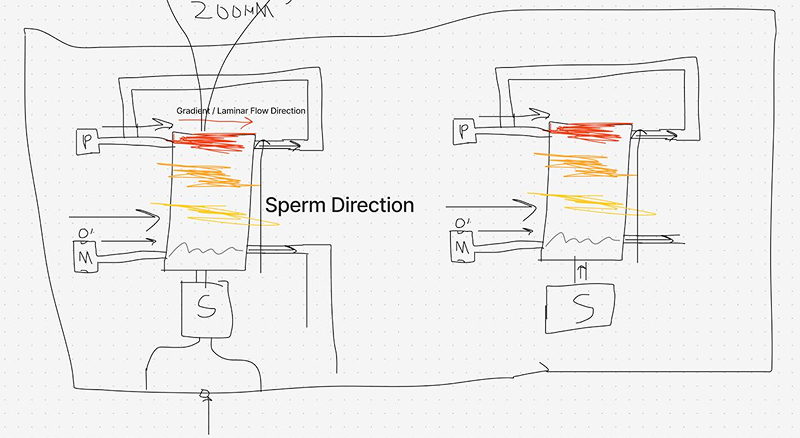
To ensure a fair start, both sperm samples are held in place behind a barrier. At go-time, the barriers are dropped simultaneously. The sperm, now free to move, will swim towards the finish line guided by the chemical gradients and fluid dynamics of the racetrack. Everything, from temperature to fluid viscosity, is controlled to mimic a natural fertility environment.
All tracked in real-time. High-resolution microscopes paired with optical sensors and imaging software monitor movement, speed, and pathing. The race is broadcast with live commentary, stats overlays, and even slow-motion replays.
Once a winner is determined - the sperm that crosses the finish line first - the results are logged. The sperm samples are either ethically disposed of or, if previously agreed upon, donated to a sperm bank. It is equal parts science fair, performance art, and new-age fertility analytics.
In a world defined by spectacle, maybe that is exactly what we need. Definitely looking forward to the next race and the show the guys have set for us.
Fertility is in a bad place. I’m hoping that Sperm Racing can be a spark in people’s minds to begin actioning the problem at hand.