

There is a fairly strange limitation at the centre of NFTs. We spent the better part of the last cycle building an entire market around the idea of digital ownership, yet the objects we created were themselves remarkably limited in what they could own or do.
An ERC-721 can represent ownership of an artwork, game character, membership, domain or almost anything else developers decide to attach to it. It can move between wallets and interact with applications built to recognise it. What it cannot naturally do is behave like the wallet holding it. An NFT does not, by itself, have an account through which it can hold ETH, own other NFTs or execute arbitrary actions on-chain.
ERC-6551 is an attempt to change that.
The proposal introduces token-bound accounts, or TBAs: smart contract accounts controlled by individual NFTs. Rather than treating an NFT exclusively as an asset sitting inside somebody else’s wallet, ERC-6551 gives that NFT an account of its own. The NFT can consequently hold other assets, interact with applications and accumulate an on-chain history, while control of the account follows ownership of the NFT. Importantly, none of this requires existing ERC-721 contracts to be modified.
It sounds like a relatively small abstraction. I think the interesting part is what becomes possible once you follow it through.
From ERC-721 to ERC-6551
ERC-721 solved a fairly specific problem: how do you represent distinguishable assets on Ethereum using a common interface?
Before it, Ethereum already had experiments with unique digital assets. CryptoPunks launched in 2017 before ERC-721 existed and used its own non-standard implementation. CryptoKitties followed later that year and became one of the first applications to demonstrate what a standardised model for non-fungible assets could look like at scale. The game became popular enough to congest Ethereum and was an important early demonstration that digital scarcity could extend beyond fungible tokens.
ERC-721 was proposed by William Entriken, Dieter Shirley, Jacob Evans and Nastassia Sachs in January 2018, building a common interface around this emerging design space. From there came most of what we now associate with NFTs: generative art, PFP collections, gaming assets, ENS names and, perhaps more interestingly from a financial perspective, Uniswap V3 liquidity positions.
The standard worked remarkably well at establishing ownership. Where it becomes more restrictive is composition.
Consider a game character represented as an NFT. Over time, that character might acquire a sword, armour, currency, achievements and any number of other objects. Under the traditional model, those assets generally belong to the player’s wallet rather than the character itself. The relationship between them has to be reconstructed at the application layer.
The same problem appears outside gaming. Imagine an NFT representing an investment portfolio. The NFT can represent the portfolio, but the assets still need to sit somewhere else. A membership NFT might represent access to a community while its tickets, credentials and rewards are separately distributed to the holder’s wallet.
In each case, the NFT represents something more complex than what it can actually contain.
ERC-6551 tries to collapse that distinction.
Token Bound Accounts
The easiest way I have found to think about ERC-6551 is that the NFT becomes the owner of a wallet.
Suppose I own NFT A. Through ERC-6551, NFT A can have a token-bound account associated with it. That account can receive ETH, ERC-20s, ERC-721s and other on-chain assets, and can execute operations against other contracts. Because control of the account derives from ownership of NFT A, I effectively control it for as long as I own the NFT. If I transfer NFT A to somebody else, control over its associated account moves with it.
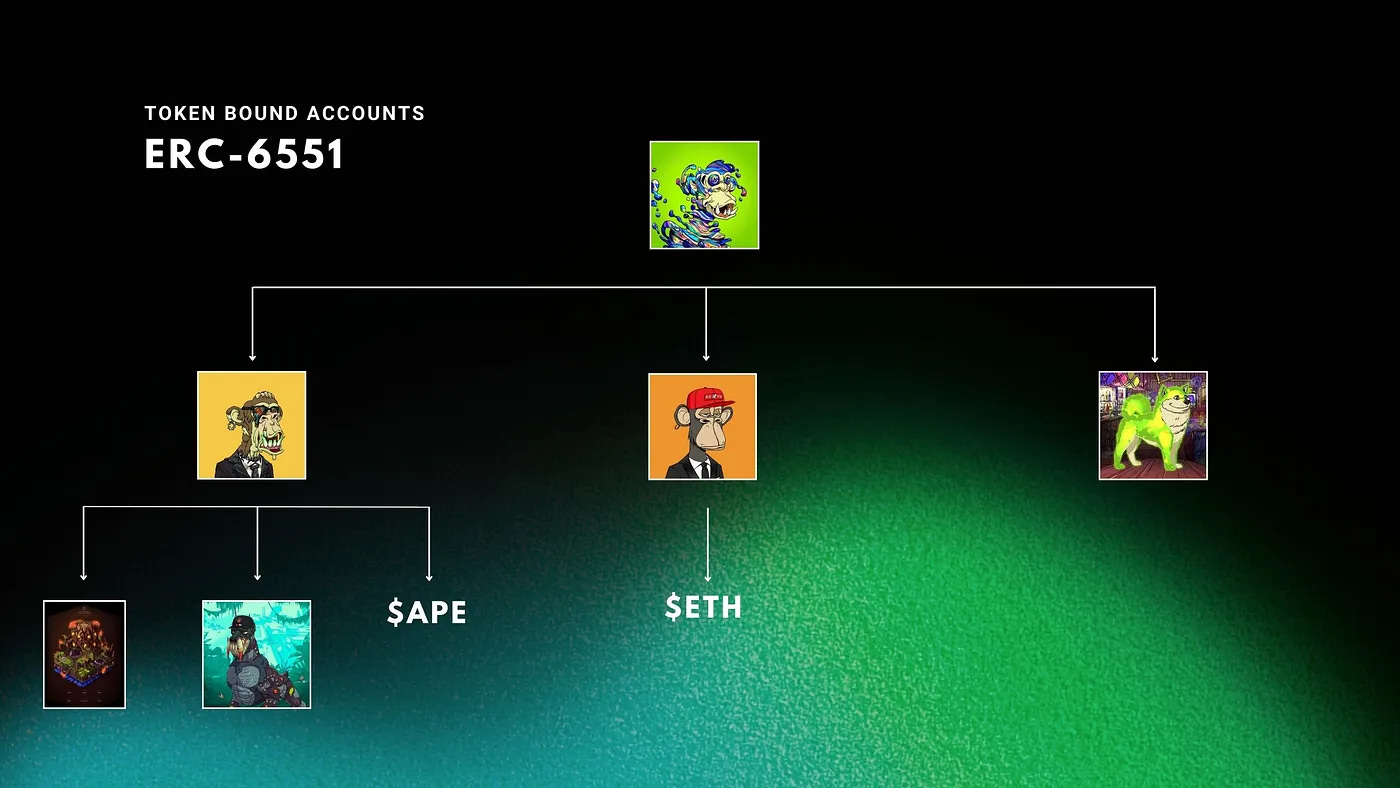
This creates a different model of digital ownership. Instead of transferring an NFT and separately transferring everything associated with it, the NFT can become the container for those assets.
Take the game character again. The character’s weapons, currency and collectables can sit inside its TBA. Sell the character, and the inventory can travel with it. The buyer is no longer purchasing an isolated token whose history and assets need to be reconstructed elsewhere; they can purchase the state accumulated around that character.
The same logic can apply to an investment portfolio. An NFT could control an account containing several ERC-20s and other assets, effectively allowing the entire portfolio to be represented and transferred through ownership of a single token. Or a membership NFT could accumulate credentials, tickets and rewards over time, turning membership from a static pass into something with its own persistent state.
This is closer to what the authors of ERC-6551 are actually proposing than the somewhat vague idea of giving NFTs “more utility.” Their examples include game characters that accumulate assets and abilities, automobiles composed of multiple tokenised components, investment portfolios and membership cards carrying a history of interactions.
How It Actually Works
The clever part is that ERC-6551 does not require every existing NFT project to upgrade its contracts.
The standard introduces a permissionless singleton registry that can create and determine token-bound accounts for NFTs. Each account is associated with a particular NFT using its chain ID, token contract and token ID, alongside an account implementation and salt. The resulting account address can be calculated deterministically, even before the account itself has been deployed.
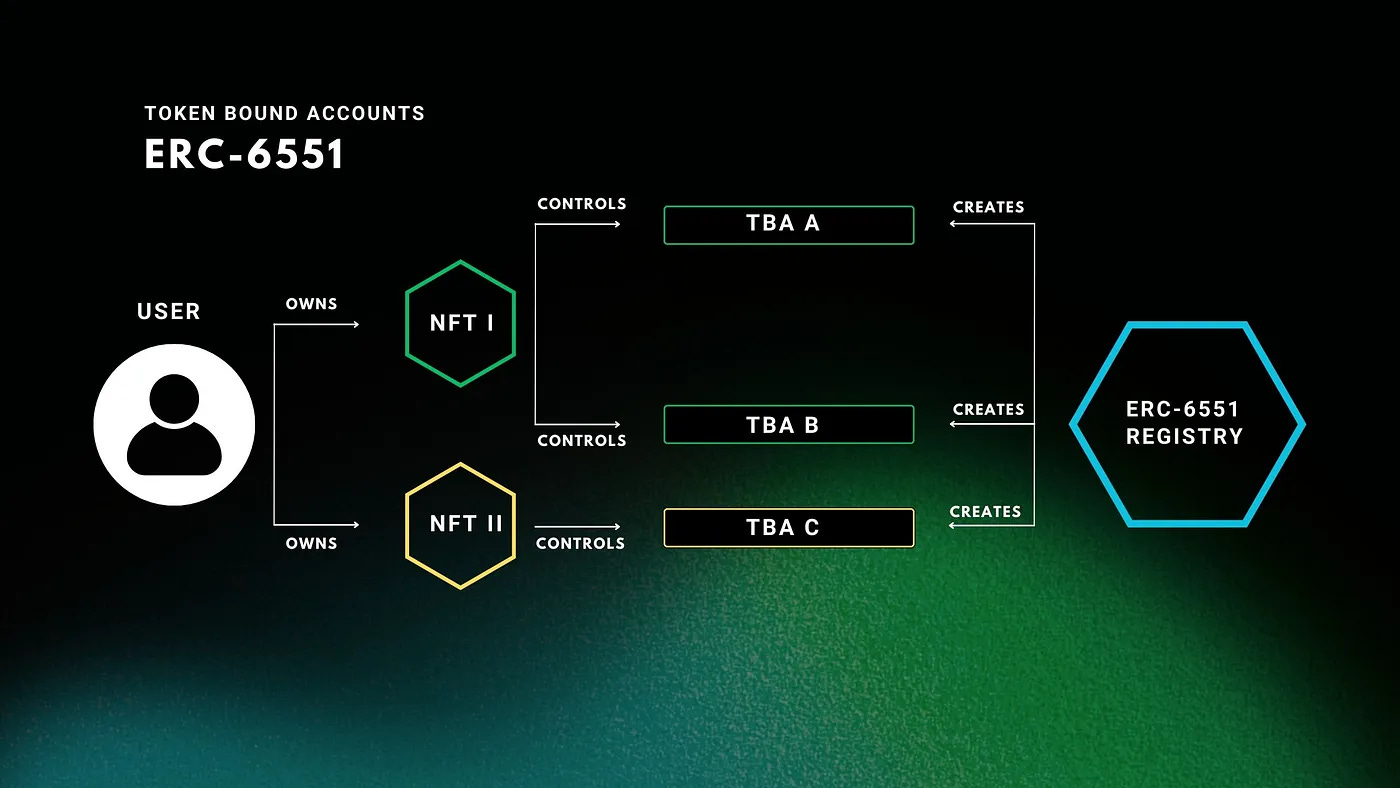
This backwards compatibility is probably one of the more important properties of the proposal. ERC-6551 does not extend or replace ERC-721. An NFT that already exists can have a token-bound account without the original collection having been designed around the standard. The registry is also ownerless and permissionless, rather than introducing a central party responsible for maintaining the relationship between NFTs and their accounts.
There is another subtle point here: an NFT is not restricted to a single account. ERC-6551 deliberately permits multiple TBAs with different implementations. That might initially seem unnecessarily complicated, but humans already use accounts in a similar way. You might have a hot wallet for interacting with applications and another for storing assets. There is no obvious reason an on-chain agent should be restricted to one account either.
The result is less a new NFT standard than an account layer built around the NFTs we already have.
The Interesting Part Is Composability
This is where I think ERC-6551 becomes more interesting.
Crypto has spent years talking about composability at the protocol level. A token deposited into one protocol can become collateral somewhere else; the resulting position can itself be tokenised and used by another application. The ability for applications to build permissionlessly on top of one another is arguably one of the more important properties of Ethereum.
NFTs have historically been much less composable.
ERC-6551 allows an NFT to sit inside that same environment as something closer to an on-chain actor. A game character could accumulate an inventory. A piece of digital art could own other works. A DAO membership could accumulate reputation or credentials. An NFT representing a financial position could hold the assets that actually constitute that position.
The NFT starts becoming less like an image with an ownership record attached to it and more like a portable object with its own state.
There is also an interesting identity primitive here. Because the account belongs to the NFT rather than directly to an externally owned account, actions can accumulate around the NFT itself. Its transaction history persists even as the underlying owner changes. An NFT could therefore develop an on-chain history that is distinct from the history of whoever currently owns it.
That is useful for games, but potentially also for reputation, memberships and autonomous on-chain agents.
The distinction is important: ERC-6551 does not itself provide these applications. It provides an account primitive from which developers can build them.
That is probably a more sensible way of thinking about the standard.
An NFT That Owns Things Is Also Harder to Value
There are some less obvious consequences.
Once an NFT owns assets, you are no longer necessarily trading the NFT alone. You may be trading an NFT together with everything inside its token-bound account. That creates an immediate problem for marketplaces.
Imagine an NFT whose TBA contains 10 ETH. I list the NFT for 11 ETH. A buyer reasonably assumes they are purchasing the NFT together with the 10 ETH held inside its account. Immediately before accepting their offer, I withdraw the 10 ETH and then sell them the now-empty NFT.
The ERC-6551 specification explicitly identifies this problem. Potential mitigations include marketplaces invalidating orders when the state of a TBA changes, committing specific assets to an order, or allowing accounts to lock assets while a sale is outstanding. Crucially, however, preventing this type of fraud is outside the standard itself.
This changes what a marketplace has to understand. Pricing a CryptoPunk is already subjective. Pricing an NFT that might contain tokens, other NFTs, credentials and arbitrary positions introduces another layer entirely.
Composability creates value, but it also creates state that applications need to understand.
The Recursive Problem
There is an even stranger edge case.
If NFTs can own accounts and those accounts can own NFTs, ownership can become recursive.
An NFT could theoretically be transferred into its own token-bound account. At that point, the NFT controls the account which owns the NFT which controls the account. Neither the NFT nor the assets inside the account can subsequently be recovered. The specification calls these ownership cycles. More complicated cycles can also occur between multiple token-bound accounts, and detecting arbitrary cycles on-chain becomes increasingly difficult as the ownership graph grows.
This is the sort of problem that sounds esoteric until people start putting meaningful value inside these accounts.
Applications implementing ERC-6551 will therefore need to think carefully about which transfers they permit and how account implementations protect users from accidentally creating unrecoverable ownership structures. The standard provides the primitive; it does not remove the usual consequences of giving smart contracts more expressive power.
That applies to security more broadly. An NFT capable of holding and moving assets creates a larger attack surface than an NFT whose primary function is simply being transferred between wallets. Account implementations, marketplaces and applications all become part of the security model.
More composability almost always means more things that can go wrong.
ERC-6551 Is Not Account Abstraction
One distinction worth making is between ERC-6551 and account abstraction.
They are complementary ideas, but they solve different problems.
ERC-6551 answers the question: what if an NFT could control an account?
Account abstraction is concerned with making accounts themselves programmable: alternative authentication, transaction batching, gas sponsorship, recovery mechanisms and other functionality that moves beyond the traditional externally owned account model.
Combining the two could eventually produce considerably richer experiences. A token-bound account could implement more sophisticated permissions or execution logic, for example. But ERC-6551 alone does not solve wallet recovery, remove seed phrases or magically improve UX. My original framing overstated this point. The standard gives NFT accounts; what those accounts can subsequently do depends on their implementation and the infrastructure built around them.
That distinction matters because otherwise ERC-6551 risks becoming another standard onto which every desirable property of crypto gets projected.
What Does This Actually Change?
The easiest mistake with standards like ERC-6551 is to confuse what is technically possible with what people actually want.
Crypto has never had a shortage of primitives looking for use cases.
There is nothing inherent in ERC-6551 that means NFTs suddenly become more valuable, that games become more enjoyable, or that users want their memberships and portfolios wrapped inside NFTs. The standard simply makes a particular ownership structure considerably easier and more interoperable.
That is still useful.
The most convincing applications to me are the ones where the NFT already represents an entity composed of multiple things. A game character naturally has an inventory. A portfolio naturally contains assets. A membership naturally accumulates credentials and rewards. In those cases, allowing the token itself to own the associated state is a fairly intuitive extension of the object it represents.
The weaker applications are probably those where ERC-6551 is added simply because an NFT can have a wallet.
Infrastructure does not manufacture product-market fit directly.
A Different Kind of NFT
The first era of NFTs was largely about proving that scarce digital objects could be owned and traded. ERC-721 provided the common language through which that market emerged. CryptoPunks, CryptoKitties, generative art and the PFP cycle all explored different versions of essentially the same primitive: a unique token whose ownership can be established on-chain.
ERC-6551 asks a slightly different question.
What if the object being owned could itself become an owner?
That sounds almost semantic, but it changes the structure considerably. An NFT can become a container for other assets, carry its state between owners, interact with applications and accumulate a history independent of the wallet currently controlling it. The underlying ERC-721 remains exactly where it was; ERC-6551 simply builds another layer around it.
Whether that becomes an important part of NFT infrastructure is much harder to know. The standard is still extremely early, and most of its proposed applications remain just that: proposed applications. It will need wallet support, marketplace support, secure account implementations and, more importantly, products where users actually benefit from the additional complexity.
But I think that is the more interesting way to look at ERC-6551. Not as something that will rescue NFTs or necessarily usher in some new era of digital ownership, but as a fairly elegant extension to an existing primitive.
ERC-721 made digital objects ownable.
ERC-6551 makes it possible for those objects to own things themselves.
That may end up being a much more consequential distinction than it initially appears.
I see immense value in using the ERC-6551 in real-world real estate assets, especially if it allows for backups of the digital asset even if the user loses their password and recovery of their wallet